Swarajya, December 31, 1960
 There is profound ethical reason why an economy governed by free prices, free markets and free competition implies moral health and plenty, while the socialist economy means moral sickness, disorder, and lower productivity.
Communism has had its day. As a spiritual and moral power it is certainly on the decline. The external military power of the leading communist States is no doubt greater than before. But if we correctly interpret developments in satellite countries as well as in Russia itself, we can see that the communist faith and appeal have entered a phase of decline.
The striking success of Germany in this direction is met with silence among the protagonists of controls, or with statistical juggling. The German success with the market economy has put collectivism on the defence. The German recovery is due to the courage and good sense which liberated the economy from the fetters of planning which had hampered or paralyzed the incentive and regulatory effects of free prices and free competition. Economic freedom like any other freedom requires eternal vigilance. As Goethe said, it must be conquered anew each day.
The welfare State must be dismantled except for an indispensable minimum, and the money thus saved left to non-governmental forms of social services. The party in power wants the machinery of the welfare State to remain so that through that machine it may perpetuate itself at the cost of the tax-payer. We have to defeat this partisan purpose.
Market economy and the revitalization of vaisya dharma are what will activate economy and preserve human freedom. Wilhelm Ropke does not use this Indian term, but this is exactly the code of ethics which he pleads for, describing it in Western terminology.
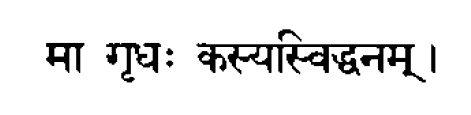
~ Isopanishad
The free society is not to be built on envy
~ Lionel Robbins
A Humane Economy is the title of a recent book by Wilhelm Ropke.* This internationally acclaimed economist leads an epic attack against the economy and polity which the present Government of India have unfortunately adopted as the panacea for all our ills.
As against socialism, Wilhelm Ropke champions an economic order ruled by freedom in the shape of free prices and free markets. He explains how this is the only economic order compatible with human freedom, and with the rule of law, the fundamental conditions without which life can have no meaning or dignity. People may be led by human convictions to declare themselves in sympathy with socialism, but they fail to see what this ultimately means. It means a social and economic order which destroys human freedom.
The technique of socialism is economic planning, nationalization, the erosion of property, and the cradle-to-the-grave welfare State. The irrefutable testimony of the last fifteen years shows that the technique of the age-old free economy leads to well-being, freedom, the rule of law, and the more even distribution of power, and to international co-operation.
There is profound ethical reason why an economy governed by free prices, free markets and free competition implies moral health and plenty, while the socialist economy means moral sickness, disorder, and lower productivity. The free economic system releases and utilizes the forces inherent in individual self-assertion. The socialist system suppresses them and wears itself out in opposing inherent natural forces. A government which, in peace time, relies on exchange control, price control, and confiscatory taxation has little, if any, more moral justification than the individual who, as against it, defends himself by circumventing or breaking the law. Economic policy should be adopted to man, not man to economic policy. This is humane as well as politically wise. The socialist intellectuals suffer from the libido dominandi and nurse open or secret ambitions to occupy positions of command in the economic system they moralise for. Their eye is on power, while they pretend compassion.
The socialist ideal is marked by mass and concentration, Individual responsibility, life and thought are to be smothered. It wants collective thought and feeling. The small circles - from the family up - with their human warmth and natural solidarity have to give way before mass and concentration, before the rootless amorphous conglomeration of people in cities and industrial centres, before the anonymous bureaucracy of giant concerns and ultimately of government which holds this crumbling mass together through the coercive machinery of the welfare States the police and the tax screw. The home is to be substituted by the street. As against this, we ought to stand up for decentralization and de-proletarianization. People need to be taken out of the mass and given roots again. We shall save ourselves only if more and more of us “have the courage to take counsel with our own souls in the midst of the socialist and planning bustle and to bethink ourselves of the firm, enduring and proved truths of life”. It is in this religious conviction that Wilhelm Ropke writes this book.
Communism has had its day. As a spiritual and moral power it is certainly on the decline. The external military power of the leading communist States is no doubt greater than before. But if we correctly interpret developments in satellite countries as well as in Russia itself, we can see that the communist faith and appeal have entered a phase of decline. But though it is a fact that the star of communism as a substitute for religion is declining, we have the development of a new Gorgon’s head. What we have to fear is the communism of the non-communist governments, the creeping inflation and the psychological deterioration closely connected with inflation in States following the welfare State policy in their apprehensions about communism to success at the polls. Personal comforts are more highly rated than freedom, law, and personality. The individual means less and less, mass and collectivity more and more, the net of servitude which hems in personal development in the welfare State becomes ever denser, more closely meshed and inescapable. The centre of gravity of decisions keeps shifting upwards from the individual, the family and the small compact group up to anonymous institutions. The power of the State grows uncontrollably. Demagogy and pressure groups turn politics into the art of finding the way of least resistance and immediate expediency or into a device for channelling other people’s money to one’s own group. Law and the principles of law become uncertain.
Once the individual had an inalienable right to life, liberty and property. But today in the ‘free world’, the last named pillar is badly dilapidated. Few realize that its fall would pull down the pillar of liberty as well. The remaining pillar, the right to the inviolability of life cannot long stand alone. If property is degraded into precarious de facto possession depending on the whim of government or on the voters favour, if property becomes a hostage in the hands of those who own less or nothing, if property together with its inseparable concomitant, the law of inheritance, ceases to be one of the primary rights which need no other justification than that of dharma, then the end of free society is in sight.
No great perspicacity is needed to recognize the close kinship between lack of respect for property and indifference to the value of money. Erosion of property and erosion of money go together. Resistance to this process of deterioration has been successful in Switzerland, Belgium, Italy and Germany. These have extricated themselves from the morass of inflation and economic controls. The striking success of Germany in this direction is met with silence among the protagonists of controls, or with statistical juggling. Arguments are brought up by some that currency reform and Marshall Aid were the good fairies rather than the market economy, or that it was all due to the special fact that Germans were a hard-working, frugal and thrifty people These evasive explanations have all been set at rest. The German success with the market economy has put collectivism on the defence. The German recovery is due to the courage and good sense which liberated the economy from the fetters of planning which had hampered or paralyzed the incentive and regulatory effects of free prices and free competition. As a result of the German success, nationalization and planning, the catch phrases of the immediate post-war period, have lost their appeal, and even in the socialist camp the response is now weak where the voters are intelligent and mature.
Economic freedom, like any other freedom, requires eternal vigilance. As Goethe said, it must be conquered anew each day. “Residues of collectivism like unexploded mines are lying scattered about even in the countries liberated from controls.” People are still in the habit of taking refuge in official regulations whenever a new problem turns up. They still tend, in the name of economic and social security, to heap new tasks on the government and thereby new burdens on the tax-payer. Again and again we see ourselves cheated of the hope of reducing to tolerable limits the crushing weight of taxation, which in the bug run is incompatible with a free or even moderately sound economy and society. The Governments budgets seek to absorb a high percentage of the national income through various kinds of compulsory contributions. This reinforces inflationary pressure and has a disintegrating and ultimately paralyzing effect on the economy. Households and firms make financial decisions with an eye towards the tax-collector rather than towards the consumers and the market. Incentive is weakened at all levels and in all spheres. ‘Saving is depressed below the level necessary to finance growth investment without inflationary credit-expansion. The rate of interest loses its essential efficacy, because as a cost factor it takes second place after tax payments.” The combination of over-expansion of public expenditure and the reorientation of its purposes in socialist directions constitutes a source of continuous inflationary pressure.
The Government, spurred by the vested interests of the civil service, tries to acquire more and more management of industries and trade, and seeks to create strongholds of public power, monopoly and party patronage. It fosters an irrational, hostile attitude towards everything that goes by the name of capital or entrepreneur, with a stubborn misconception of the latter’s task and the conditions in which he can function.
Concentration is the great evil of our times: concentration of the power of government and administration, concentration of economic and social power under the state, concentration of decision and responsibility which become thereby more and more anonymous, unchallengeable and inscrutable, concentration of people in organizations, towns and industrial centres, and firms and factories. The common denomination of the social disease of our times is concentration. Collectivism and totalitarianism are the extreme lethal stages of the disease. The bloated Colossus of the State, with its crushing taxation and boundless expenditure, is chiefly to blame for the inflation that is a chronic evil of our times.
An excess of government intervention, deflecting the national market economy from the paths prescribed by competition and price mechanism, an accumulation of prohibitions and commands, the blunting of incentives, official price-fixing and restrictions on primary economic freedom necessarily lead to mistakes, bottlenecks, inefficiency and failure of performances, and imbalances of all kinds. With the proliferation of intervention, they end up in general chaos. The disturbances caused by intervention are taken as proof of the inadequacy of intervention and become a pretext for yet more and stronger intervention.
Wilhelm Ropke quotes from Tocqueville who saw what was coming:
The government covers the surface of society with a network of complicated rules, minute and uniform, through which the most original minds and the most energetic characters cannot penetrate, to rise above the crowd. The will of man is softened, bent and guided. Men are not forced by it to act, but they are constantly restrained from acting. It does not destroy, but it prevents existence. It does not tyrannize but it compresses, enervates, extinguishes and stupefies a people, till the nation is reduced to nothing better than a flock of timid and industrious animals of which the government is the shepherd.
The dominating motive of the welfare State today is not compassion but envy. The language of the old paternal government is becoming a screen that hides the new crusade against anything which dares exceed the average, be it income, wealth or performance. In the name of economic equality and to the accompaniment of the progressive blunting of individual responsibility, a substantial part of private income is constantly sucked into the pumping engine of the welfare State and diverted by it with considerable friction-losses. Everything into the same pot, everything out of the same pot - this is the ideal.
The individual and his sense of responsibility constitute the secret mainspring of society, and this mainspring is being broken by the welfare State. “It is surely the mark of a sound society,” says Ropke, “that the centre of gravity of decision and responsibility lies midway between the two extremes of individual and State, within genuine and small communities of which the most indispensable primary and natural unit is the family. And surely it is our task to encourage the development of the great variety of small and medium communities and thereby of group assistance within circles which still have room for voluntary action, a sense of responsibility and human contact and which avoid the cold impersonality of mass social services.”
If the State increasingly takes upon itself to hand out welfare and security on all sides, first to the advantage of one group, then of another, it must degenerate into an institution which fosters moral disintegration and prepares its own eventual doom.
People do not always realize that when they turn to the State for the fulfilment of their wishes, their claims can be satisfied only at the expense of others. A money claim on the State is always an indirect claim on somebody else whose taxes contribute to the sum demanded. It is a mere transfer of purchasing power through the medium of the compulsory powers of the State. The more widely the principle of the welfare State is applied, the closer comes the moment when the giant pumping engine turns out to be a deceiver of everybody and becomes an end in itself, which eventually serves no one except those who make a living out of its manipulation, namely, the bureaucrats. These naturally have an interest in obscuring the facts.
Today the time of illusions is past. It has become clear and it is widely realized, especially in Great Britain that if one seriously wishes to put the welfare State into practice, one has to use taxation to stir up income distribution at all levels and has to draw even on the lowest income groups to help finance the cost (through indirect taxes as in this country, if it is impossible to levy direct taxes on the poor). The money is conjured up from people’s right pocket into their left with a detour via the treasury and the enormous friction-losses entailed thereby.
“It has become clear that there is a price to be paid in the form of costs of the ever-increasing State machinery, of a blunting of the will to work and of individual responsibility. Vexation at the top and envy at the bottom choke civic sense, public spirit, creative leisure, neighbourliness, generosity and genuine sense of community. What will remain is the pumping engine of Leviathan, the insatiable modern State.”
The welfare State must be dismantled except for an indispensable minimum and the money thus saved left to non-governmental forms of social services. The party in power wants the machinery of the welfare State to remain so that through that machine it may perpetuate itself at the cost of the tax-payer. We have to defeat this partisan purpose. We cannot give up economic freedom and hope to save other freedoms. Market economy and the revitalization of vaisya dharma are what will activate economy and preserve human freedom. Wilhelm Ropke does not use this Indian term, but this is exactly the code of ethics which he pleads for, describing it in Western terminology.
It is not poverty that leads a nation to communism, but the break-up of traditional values. And this condition is being rapidly brought about by the present rulers of India.
* A Humane Economy by Wilhelm Ropke, translated into English by Elizabeth Henderson: Henry Regnary Chicago, 1960.